I have a habit of mulling over posts long after I’ve read them, but a bad habit of not taking a screenshot of said memes or posts.
I saw it because it was under a hashtag I follow, #mentalhealthmatters . (Sadly, people post all kinds of wildly unrelated stuff under this hashtag as well.)
So I’ll have to roughly paraphrase what I saw, from memory:
“Hey loser. You wonder why this generation is depressed, anxious, a hot mess? Stop scrolling Instagram all day, bingeing Netflix, eating crappy processed shit, and complaining all the time.”
– random internet Professional looking know-it-all DUDE
(c) 2021
Oh man. Whatever his exact words were, the post just smacked of dismissive arrogance, elitism, and a total lack of compassion for people who struggle with their mental health. And did this guy get served back that viral heat in the comments section!
Commenters pointed out his privilege, our unprecedented public health crisis, the cost of living v. stagnant wages, the inaccessibility of mental health care, the exacerbating cultural divide in the U.S., and this generation struggling to achieve financial flexibility and independence. Among other things.
He clearly deserved it.
I mean, reading that post, I bristled and was instantly on edge.
But as I moved on through my day, and mulled (as an overthinker often does), I thought about how more than one thing can be true.
In 2021, there are no shortage of systemic struggles that make life, liberty, and the pursuit of happiness a challenge to achieve these days.
… and …
There are all kinds of ways to cope with those struggles. Including the “crap” listed above by Sir Smarty Pants.
I remember when I first started formatting some intake papers for a therapy group I spent a little time with. I was hitting the big items, considering personal and medical history, daily routines, employment, family dynamics, how struggles were manifesting, and how the person was coping with them.
I think I listed it as something like “coping mechanisms.”
My supervisor pointed out the breadth of what coping can look like.
I mean, ideally, we think of things like exercise, setting boundaries, meditation and prayer, creative projects, taking your vacations, tapping, engaging with a strong social support network.
But it also means drinking alcohol, crying, checking out mentally, picking our skin or biting our nails. It can mean sleeping too much, isolating ourselves, shopping too much, showering too little, or calling in sick too often.
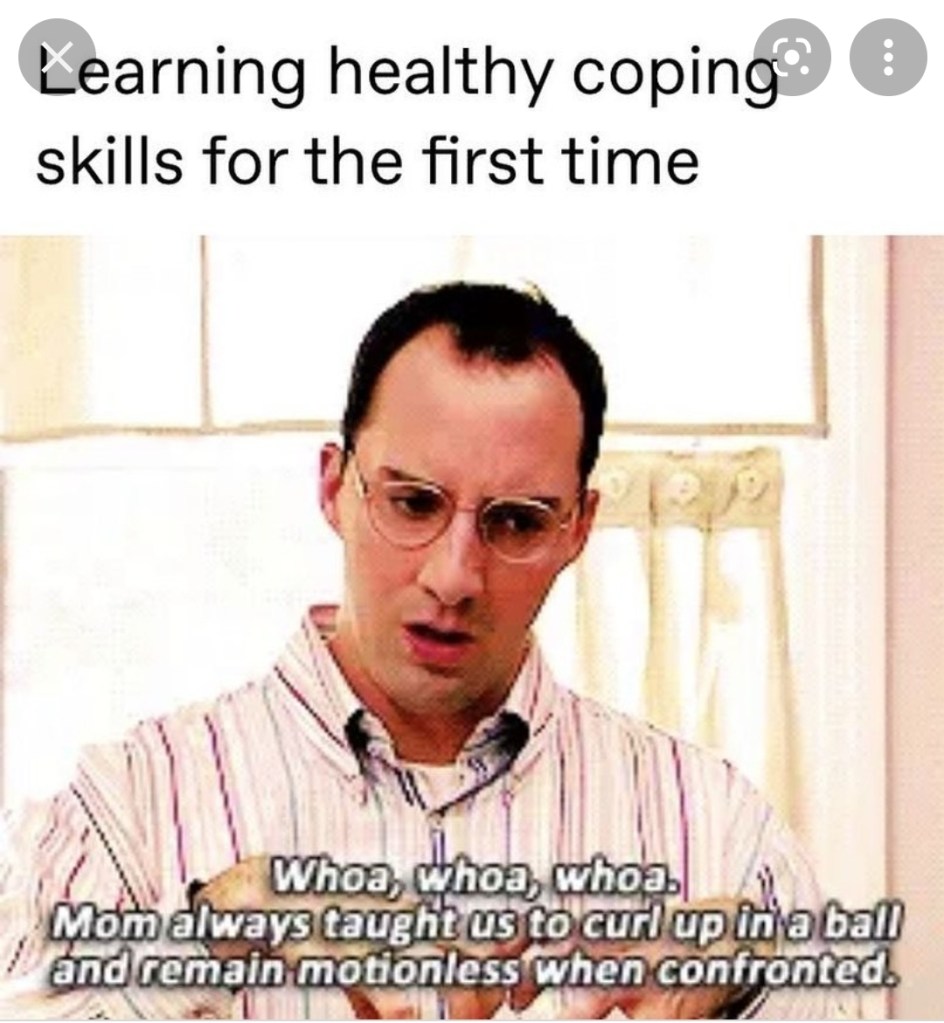
The lists vary wildly, but both lists are a person’s attempts to cope.
And people, indeed, do things from both lists.
“So, maybe list it as healthy coping mechanisms AND unhealthy coping mechanisms?”
My supervisor pointed out the power of words.
She steered me toward “helpful” and “unhelpful.” Because, in the moment, she argued – a person overwhelmed by stress, rumination, panic – coping can look SO many different ways and in that moment, that is what a person needs.
This may be a little controversial.
I am not saying, “Hey good for you! Self harming is a means of coping! Keep it up!”
I’m recognizing that in the moment, this is where a person is. And this place is not a place for judgment and telling a person how that is a problem too. (Trust me. They’ve already judged themselves.)
Because for a while, the “unhelpful” can help… until it doesn’t.
Until it just adds to the problems.
And then we need to examine it.
That’s what this post struck me as: Judgment, dismissive of a person’s history or circumstances, dressing itself up as “truth” or “tough love.”
Ideally, in therapy, we learn from our client about where they are, and help them move from unhelpful coping mechanisms to more helpful coping mechanisms.
Are mindlessly scrolling Insta, bingeing Netflix, complaining, and eating crap some magical END GOAL of self-care?
No, of course not.
But for a while, they can help people who are in a bad place, to cope with whatever aspects of reality are currently crushing them.
I have compassion for a person in that place, NOT ridicule or insults.
People generally come to therapy because they want to move toward healthier responses to their anxiety, anger, sleepless nights.
And therapy can help with that.
But in my book – my school of thought – compassion and understanding a person’s reality comes first.
Then we can look at how your needs are being met, how your actions effect your well-being, and how your thoughts shape your reality.
Then we can examine what you’re taking in, and how it’s helping you or hindering you from where you want to be.
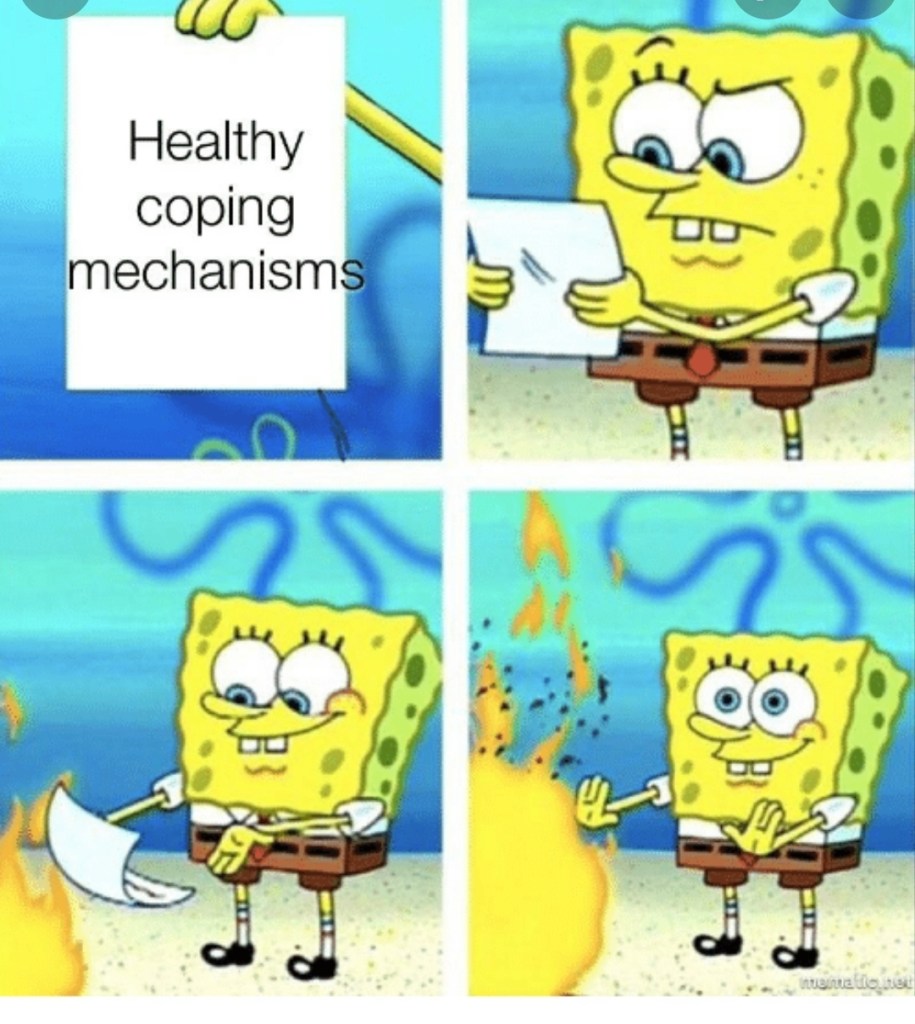
And that’s the truth: life is hard, coping can look like all kinds of different things, but ultimately what we do choose to consume ot surround ourselves with shapes our lives (for better or worse)!
Humans get stuck, stagnant, frustrated. We dig in our heels. Change is too hard. We cross our arms, hold grudges, burn bridges, walk away.
But humans, and our sweet neuroplastic brains, are also capable of learning and unlearning, growing, changing, and evolving. We are capable of surprising ourselves!
We are always in progress.
Sometimes our anxious selves just want the certainty that one way of being and doing is the Right Way.
“In flux” is inherently uncomfortable.
But as time marches on – and I try to practice what I preach – I’m very often reminded that unhelpful and helpful can all be more closely linked than we realize, that linear movement isn’t all that common, and that more than one thing can be true.

 alive. awake. uncomfortable.